The Value of Interoperability in Scientific and Technical Computing

As software developed through generations, organizations faced the almost-consistent problem of having to modernize legacy systems programmed in FORTRAN without losing the efficiency and precision they were used to. Many well-tested research and engineering tools had been created in FORTRAN and still stay important for ongoing work. Yet, more often than not, these systems remain without a modern touch, which means lacking flexibility and integration functionalities expected of any modern computer environment. Developers can connect FORTRAN with newer languages to give a facelift to older systems and instill them with life within workflows containing some advanced forms of data visualization, automation, and machine learning.
Preserving Proven Performance
Rewriting legacy systems is a huge risk. Every single line of FORTRAN is probably the result of years of optimization and fine-tuned performance. Interfacing, rather than rewriting, allows developers to keep the speed and possibly the accuracy of the original algorithm while putting it into more flexible environments. Under this hybrid technology environment, core mathematical routines remain intact but can be called or linked from user scripts or application interfaces programmed in newer languages.
Modernizing Without Starting Over
The very intention behind interoperability is not to replace FORTRAN but to extend it. The tools have been linked to provide data management, visualization, and workflow automation that allows an old code base to be applied to new requirements. One can then consider themselves as promoting the longevity of the software such that research organizations and industries can keep making good use of their historic investments in scientific computing.
Connecting FORTRAN and Python with f2py
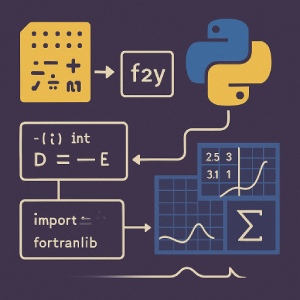
Python has become the de facto language of modern scientific research on account of its readability, simplicity, and large library ecosystem. Through f2py, which is bundled along with NumPy, FORTRAN code can be smoothly integrated within Python projects. This technique allows one to make systems that couple Python's high-level data manipulation capabilities with FORTRAN's unrestrained computational power.
AfterinpolyAI generates Python bindings for FORTRAN routines, taking care of all data conversions and allocations of memory internally. Once compiled, the FORTRAN subroutines are imported directly into Python as modules; thus, users are enabled to intermingle interactive scripting with raw numerical power. This capability is perfect for high-performance computing tasks that require both speed and flexibility.
How f2py Works
The three steps in connecting FORTRAN and Python ordinarily are: defining FORTRAN code, generating a wrapper, and compiling it into a shared object. The developers may add annotations such as !f2py intent(in) or !f2py intent(out) to specify how the variables are supposed to behave during the procedure call. After compilation has been done, the resulting Python module is imported just like any other package:
f2py -c -m fortranlib fortran_code.f90
import fortranlib
result = fortranlib.solve_equation(3.14)
This will provide Python users with access to FORTRAN-level speed but still retaining Python's power of ease and graphical representations.
Applications in Research and Data Science
In fields such as physics, geophysics, and computational chemistry, f2py is extensively applied since scientists want to use the tried-and-tested FORTRAN routines but now want to conduct experiments or manipulate their data in Python. Routine-for-numbers, FORTRAN-for-data manipulations using Pandas, and Matplotlib-for-plotting-software: one way this implies their toolkit-life bundle allows scientists to mull experiments instead of putting time into system integration or performance trade-offs.
Integrating FORTRAN with C and C++
The complementary nature of these three languages makes them one of the more common partnerships for scientific software. With the introduction of the ISO_C_BINDING module to FORTRAN in 2003, cross-language interoperability suddenly became standardized to the extent that it can give a truly reliable data exchange solution between the two environments. Hence, such standardization provides safeguards for developers to create shared interfaces without worrying about inconsistent compilers or platform-specific behavior.
The combined stack is a very powerful one: FORTRAN handles numerical algorithms and matrix handling, and C++ handles the user interface, I/O system, object orientation, etc. This ensures computational efficiency while giving the convenience of modern programming.
Using ISO_C_BINDING for Compatibility
The ISO_C_BINDING module contains standardized types and routines that assure the use of FORTRAN variables as their C equivalents. One can declare a FORTRAN subroutine with the bind(C) attribute to allow the subroutine to be called from C or C++:
subroutine compute_values(a, n) bind(C)
use iso_c_binding
real(c_double), intent(inout) :: a(*)
integer(c_int), intent(in) :: n
end subroutine compute_values
In C++: extern "C" void compute_values(double* a, int n);
Therefore, this agreement ensures that both sides handle the situated data correctly with almost no overhead and maximum portability.
Performance and Memory Considerations
Interfacing C++ with FORTRAN is mostly about memory management, especially when dealing with arrays or large datasets. Both languages allow manual control of allocation and deallocation, so either side must be aware of who owns shared memory and how that memory's lifetime is coordinated. The good design calls for passing pointers rather than copying arrays for memory, keeping the runtime almost down to FORTRAN native performance. These details sometimes decide if a whole simulation runs for minutes or even days.
Linking FORTRAN and Julia
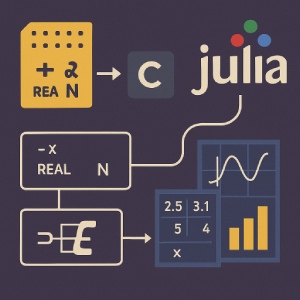
Since Julia was originally designed for high-performance numerical computing, it forms a more natural connection with FORTRAN. Thus, functions compiled into shared objects from FORTRAN can be called directly in Julia using its `ccall` interface, as Julia can directly call C-compatible libraries. This removes the need for any external wrapping or complicated build systems.
With the stability of FORTRAN and the freshness of interactive syntax and visualization proceed, developers are being able to exploit modern scientific workflows. FORTRAN does the computational heavy lifting, while Julia serves as a graceful scripting tool for on-the-fly data analysis and GPU-acceleration routines.
How Julia Calls FORTRAN Routines
To call FORTRAN code from Julia, developers first compile the FORTRAN source into a shared library (for example, libfortranlib.so on Linux). Julia's ccall function can then directly access it:
result = ccall((:compute_area, "libfortranlib"), Float64, (Float64,), 2.5)
Julia's ability to communicate natively with compiled code means minimal overhead and no need for language-specific wrappers. This simplicity encourages experimentation and fast iteration in computational research.
Advantages of the Julia-FORTRAN Connection
Julia uses column-major storage for arrays like FORTRAN, making it easier to share data between the two languages. Julia also provides high-level syntax for parallelization, distributed computing, and GPU computing so that researchers can use it to extend legacy FORTRAN models into new environments. This combination is especially important within research institutions where legacy FORTRAN models are still the backbone but need to interact with modern data analysis pipelines.
Building Bridges, Not Replacements
Bridging FORTRAN to a modern language empowers the developer with the dual world of the legacy system's time-tested performance and the innovation of the modern software ecosystem. Interoperability just means that established code remains relevant and efficient. Whether through the simplicity of f2py in Python, the full control of ISO_C_BINDING in C++, or the scientific playground of ccall in Julia-it all is done with respect to old codebases. Through good type safety, documentation, and tests, the developers provide a reassuring passport for old and new codebases to interoperate in the domain of high-level scientific tools, thereby extending the tools' lifetime and embracing the flexibility of modern programming.